Discover the IRL’s initiatives in 2025.
2025: A year of new challenges for the IRL
The year 2025 marked an important milestone for the IRL, with the selection of five new research projects following competitive calls for proposals. These successes reflect the quality and relevance of the work carried out by our teams.
Two projects were selected by the Fédération Wallonie-Bruxelles under the FRHE funding scheme for research in Haute Écoles : FRiSBEE, led by Roxane De Hoe, Marine Falize and Marine Jaeken, explores the multiple dimensions of entrepreneurs’ health and well-being FIDDLE, conducted by Christel Dumas, Tom Duterme and Félicien Pagnon, examines the actors and mechanisms at the heart of green bonds.
Three additional projects were funded by ARES through different programmes. Fresqu'EDD (with Laurent Lahaye) aims to evaluate and reinvent pedagogical practices related to thematic workshops (such as the Climate Fresk) in higher education. RECAPES-B (led by Frederik Claeyé),, supported by the Amorce programme, which funds institutional capacity-building projects in university cooperation, seeks to strengthen research capacities in social entrepreneurship in Benin. Finally, PME EF Kivu (by Laurent Lahaye), funded through the PRD-PFS programme dedicated to training projects in the Global South, analyses the determinants of resilience among family SMEs in Kivu. The project is structured around three major themes: family dynamics, entrepreneurs and culture.
These grants reflect the commitment of funders such as ARES and the Fédération Wallonie-Bruxelles to support innovative and socially engaged research in Haute Écoles.
Throughout 2025, numerous events and presentations also helped to promote a strong research culture at ICHEC. Six “Midis de la recherche” sessions showcased the work of Isabelle Choquet with Olivier Ransquinet, Laurence Lievens with Fabienne Baise and Caroline Waucquez, Céline Engelbeen, Catherine Dal Fior with Cyrille Kousse Guilekun, Félicien Pagnon, and Anaïs Angelucci. In addition, six Quaresmi seminars on quantitative methods were organised, as well as seven sessions of BEERS — the new Belgian Ecologic Economics Research Seminars of the IRL. Finally, three conferences were organised or co-organised: the Equinoxe seminar of the SustainLab, dedicated to the question “How to successfully adopt transversality in sustainability research?”; the Political Economy Working Group Workshop on “The EU Political Economy in Times of Crisis”; and the Business and Society Seminar, focused on the theme “How can organizations create meaningful and impactful societal progress?”.
The year 2025 marked an important milestone for the IRL, with the selection of five new research projects following competitive calls for proposals. These successes highlight the quality and relevance of the work carried out by our teams.
RECAPES-B and social entrepreneurship in Benin
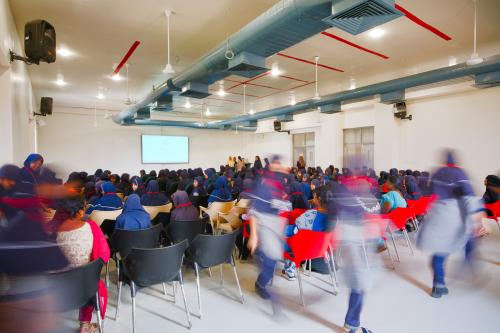
This project, led by Frederik Claeyé, aims to strengthen research capacities in social entrepreneurship in Benin, in collaboration with the University of Parakou and a colleague from the London School of Economics. A first webinar organised in September with key stakeholders helped identify the most pressing needs on the ground and refine the project’s direction. Frederik is now preparing an introductory webinar for early-career researchers in December 2025, followed by a series of in-person training workshops in Parakou in January 2026.
These workshops will cover the full research process: qualitative and quantitative data collection, data analysis, ethical considerations, and scientific dissemination. They will also provide practical tools that participants can immediately apply to help them structure, conduct and promote their own research projects. The objective is to support the emergence of a new generation of Beninese researchers capable of producing knowledge rooted in local realities and actively contributing to the development of relevant and sustainable social innovations.
PMEF Kivu and the resilience of family SMEs
ICHEC, in partnership with UCBukavu, UCLouvain and UMons, is also developing a research and training programme dedicated to family SMEs in the Kivu region (PMEF Kivu). Coordinated by Eddy Balemba (UCB) and Laurent Lahaye (ICHEC), the project aims to strengthen the research and action capacities of UCB in supporting family entrepreneurship in Kivu.
The team—also composed of Patrick Murhula and Adolphe Mmenge (UCB), as well as Anaïs Angelucci (ICHEC)—conducted a field mission in early December in Cyangugu, near Bukavu. The various workshops provided an opportunity to examine the contexts and needs of actors within the entrepreneurial ecosystem, through meetings with more than 30 entrepreneurs as well as managers of incubators, financial institutions and public partners from Bukavu.
The project, which is expected to officially begin in September 2026, will lead to three doctoral theses addressing topics such as family dynamics in SMEs, women’s entrepreneurship, access to finance, and the links between religion and entrepreneurship.

FIDDLE and green bonds
At the intersection of the literature on sustainable finance and the social studies of finance, the FIDDLE project examines the social construction of green bonds, a new financial instrument presented as essential for financing the ecological transition. Christel Dumas, Félicien Pagnon and Tom Duterme compare different types of green bonds (issued by public and private actors, financial and non-financial) using qualitative research methods. Their objective is to map the actors involved and identify the interactions and power asymmetries between them—issuers, evaluators, regulators, buyers, and others.
This research project will run from October 2025 to September 2027.
FRISBEE and mental health
The FRiSBEE research project focuses on the Facets and Representations of Entrepreneurs’ Health and Well-being. Its objective is to develop concrete avenues for action—based on robust empirical research—to help preserve, improve and restore entrepreneurs’ health and well-being.
The project will run from October 2025 to the end of September 2027 and is led by Marine Jaeken, Marine Falize and Roxane De Hoe, in collaboration with Amélie Jacquemin (UCLouvain). The researchers will meet with entrepreneurs and field experts and will organise workshops to refine and test the effectiveness of the selected intervention strategies. The results will be shared with entrepreneurs, policymakers and the scientific community.